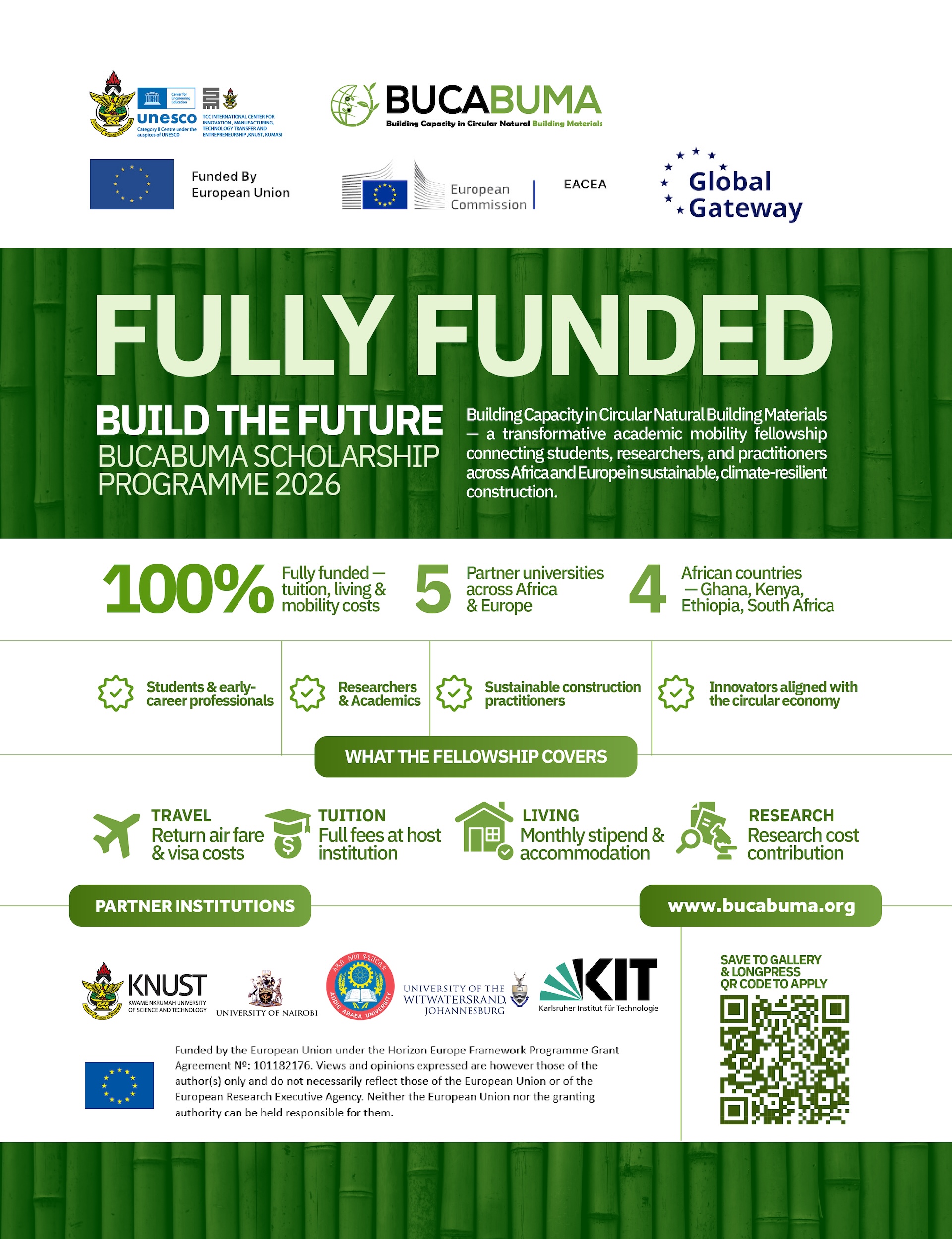
The BUCABUMA logo is a composite emblem that encodes the project's identity in four interlocking visual elements, unified by a two-tone wordmark. At its centre is a single guiding idea: inside the framework of circularity and natural building materials, it is the exchange of ideas, knowledge, technology, and mobility between people that drives transformation.
The Globe forms the emblem's structural foundation: an open, line-drawn sphere whose sweeping arcs represent both the earth and the continuous loops of the circular economy. It positions Africa not as a passive recipient of innovation but as the epicentre from which sustainable construction knowledge radiates outward. The arcs double as references to the biological and technical material cycles that BUCABUMA promotes: growing, using, composting, and repurposing natural and recycled resources to replace the linear extraction patterns responsible for 39% of global energy-related CO2 emissions.
The Bamboo rises through the globe: a literal reference to one of the project's core materials alongside clay and agricultural residues. Bamboo embodies the bridge between tradition and modernity: it is rooted in centuries of African and tropical vernacular architecture, yet it is also the subject of cutting-edge parametric modelling, digital fabrication, and engineered composite research. Its segmented geometry evokes the precision of computational design, while its rapid growth and renewability represent the regenerative construction practices the project champions. The bamboo growing beyond the globe's boundary symbolises how locally rooted solutions can transcend borders through the right networks and frameworks.
The Human Figure, nestled within the interplay of globe and bamboo, is the logo's most critical element. Placed deliberately inside the circularity and natural materials, it visualises the project's animating force: the 67 mobile scholars thus Master's and doctoral students, trainees, and academic staff, exchanging knowledge across KNUST (Ghana), UoN (Kenya), AAU/EiABC (Ethiopia), WITS (South Africa), and KIT (Germany) over 726 months of mobility. The figure is abstracted and universal, reflecting the project's commitment to gender equity (40% women), disability inclusion (10% quota), and the empowerment of artisans, entrepreneurs, and early-career professionals alike.
The Leaves extend outward and upward beyond the globe, representing dissemination, growth, and environmental sustainability. They signal that the knowledge generated through open-access publications, Living Labs, alumni networks, annual conferences, and policy advocacy will not remain confined within the consortium but will spread across Africa and into the wider world, fostering replication and long-term impact.
Read as a whole, the logo tells a clear story: the world faces a construction sustainability crisis (the globe); the solution lies in circular natural materials (the bamboo); but materials do not innovate themselves, it is the movement and exchange of people (the human figure) that creates change; and that change, once catalysed, grows and spreads beyond any single institution or border (the leaves).